5. Describe the conditions in which a graph can cross through an asymptote.
A graph may only cross a horizontal asymptote in the middle of the graph, but it can never cross the far left or the far right, where the boundaries are set.I may also cross through the middle, but a vertical asymptote may never cross in the middle.
This video is about Unit G, Graphing
rational graphs. It will show you how to solve a rational function.
·What does the viewer need to pay special attention to in
order to understand the concept?
The viewer must pay
attention to the degrees to make sure that it does or does not contain a slant
asymptote. The view must also insure that there should not be a hole in the graph,
which can be identified when canceling out anything with the top to the bottom.
The viewer must also be aware that there can be or not be a x or y intercept.
10. While the domain of a rational function depends on DIVAH, what do you think the range of a rational function depends on? Give an example.
I believe that the range of the rational function depends on the horizontal and a slant asymptotes. It may not always apply to the horizontal asymptote if the degree may be bigger than the other one.
9. Describe how to find the x-intercepts of a rational function. Include both the long way and the shortcut way, explaining why the shortcut makes mathematical sense.
To find the x-intercepts you must factor it and set it up to zero, then multiply by the denominator on both sides , and then solve for the numerator, this process is the long way. The shortcut is more reasonable because you may equal the numerator to zero rather than dividing it with the denominator. Y will always be zero because whatever you divide or multiply it will always be zero, and its easier to find the x-intercepts.
8. How do you find the y-intercept of a rational function?Does this need to be done in the original or simplified equation?
To find the y intercept for a a rational function you must first plug in all the zeros to the x, into the factored rational equation.. This must be done in the factored equation, you may either have a y intercept or not y intercept. The point will be set up as (0,y) .
7. Describe how to write limit notation for vertical asymptotes and what the notation means?
The limit notation is is usually written with a + or - sign and it indicates if it approaching negative infinity or positive infinity. The plus sign show that it is from the right side, and the - means that from the the left side. This shows us that the right side graph may being going up or down, on the left side it will show us if it is also going up or down.
6. How do we find the appropriate place to plot a hole if the y-value is undefined when plugged into the original equation?
To find the hole we have to take the factored equation and set it up to zero. Once you have the answer from the factored equation then, it will give us a undefined 0 or 0/0. we must use the simplified equation to to plug in into the x-value and then that will allow you to get he y value.You may only have a hole when you are able to cancel out the factors from the top and the bottom.
4. What is the difference between a graph having a vertical asymptote and a graph having a hole?
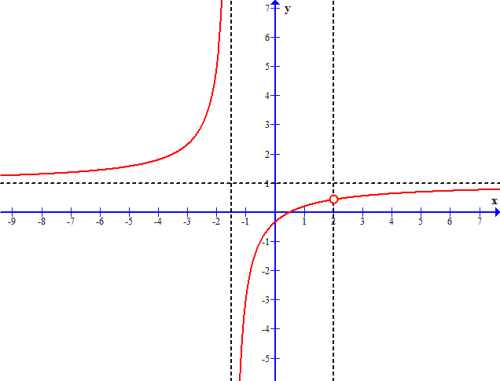
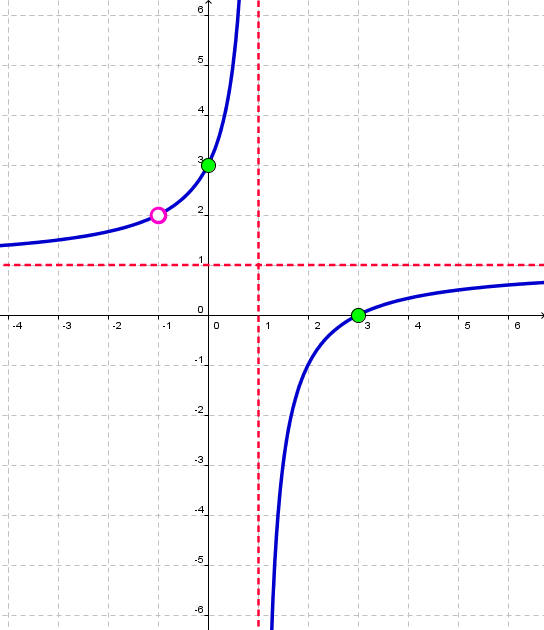
A vertical asymptote is plotted regularly, the graph may never cross through a vertical asymptote. The equation for a vertical asymptote is X= # while a hole is a ordered pair, (x,y). While a graph with a hole is plotted with an open circle rather than a closed circle.A hole may also be found when factors are canceled, the x's must be placed by a zero, and the simplified equation indicates the hole, the graph will not go through the hole but over it.
3. When does a graph have a slant asymptote? How do you find the equation of the slant asymptote?
A graph will only have a slant asymptote when the degree is one bigger on the top than the the one in the bottom. You may find the equation of a slant asymptote when using long division, then setting it up to the y=mx+b equation. the remainder will not be necessary because it will be in the y=mx+b.
2. Describe the limit notation for horizontal asymptote actually means.
The limit notation of a horizontal asymptote actually set the boundary of the graph. For example as x approaches infinity to the right f(x) approaches 2, and as x approaches negative infinity to left f(x) approaches 2. the number two is where it sets our boundary it for the graph.
1. How do we know if the graph has a horizontal asymptote?What are three options?
We can verify if the graph is a horizontal asymptote by comparing the numerator and denominator. To verify if the graph is a horizontal asymptote the degree has to be bigger on the bottom than the top. Another thing will allow us to verify the horizontal asymptote is the that if they are both the same degrees than they are the ratios of the coefficients. The equation that also helps us verify if its a horizontal asymptote is the equation y may equal any number.If there is a bigger degree on the top then we can know that there will be no horizontal asymptote.




 .
.